
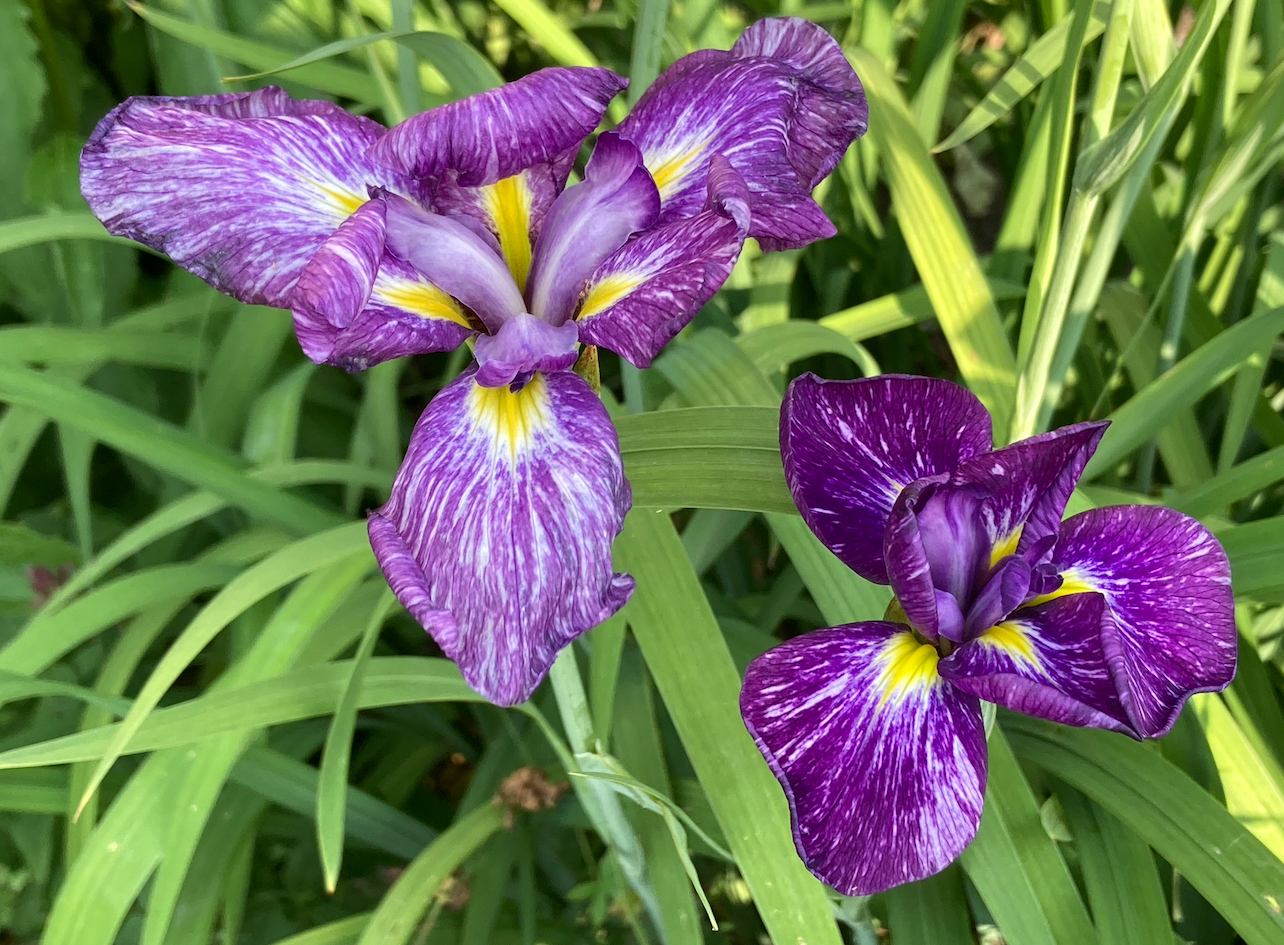
 Try this hardy iris that blooms a bit later in the season and provides color and movement to your gardens and landscape. Perennial flowers like Siberian irises may already hold a special place in your gardens and landscape. But there’s another flower in the iris family that you might consider adding for its color and movement, especially if you’ve got some soggy spots in your yard. It’s the Japanese iris.
The perennial Japanese iris, or Iris ensata, blooms later in the season, in June or early July, after the Siberian irises and other flowering perennials have come and gone. These impressive irises are tall, growing over 30 inches high with strap-shaped leaves. Their long, flat flowers bloom in a range of hues — white, pink, lavender and purple. And the petals can also have distinct and contrasting veining. The real show occurs when the summer breezes blow, and the petals’ movement almost resembles the fluttering wings of butterflies.
Japanese irises are hardy to zone 4 and don’t mind wetter soil in the spring. If you have areas in your lawn that tend to stay wetter, or if you have space stream side or near a pond, these irises will flourish. Varieties like “Silverband” grow in lavender and purple colors, while “Great White Heron” has white blooms with a flash of yellow in the center. And a newer variety, called “Pinkerton,” is a soft pink with a darker pink veining.
When planting Japanese irises, resist placing them too deeply into the soil — about 3 inches will do. And choose either a full sun or partial sun location in well-drained soil. These irises can take some extra moisture, but the soil shouldn’t be soggy. They’re rhizomatous, and will spread via underground rhizomes, but not aggressively like some perennials. Add these to your landscape and you’ll get to enjoy Japanese iris consistently year after year.